Construction
Job management software for builders, groundworkers and trades
Every job from the first enquiry to the final account on one record. The variations and whether each one is signed, the dayworks, who was on site, the RAMS for that site, the next valuation and the retention still held. Built for the way your firm already runs, hosted in the UK, and looked after by the people who built it.

What a building firm actually tracks
Six records, one job
- The job, from enquiry and quote to final account
- Variations, extras and dayworks, and who agreed them
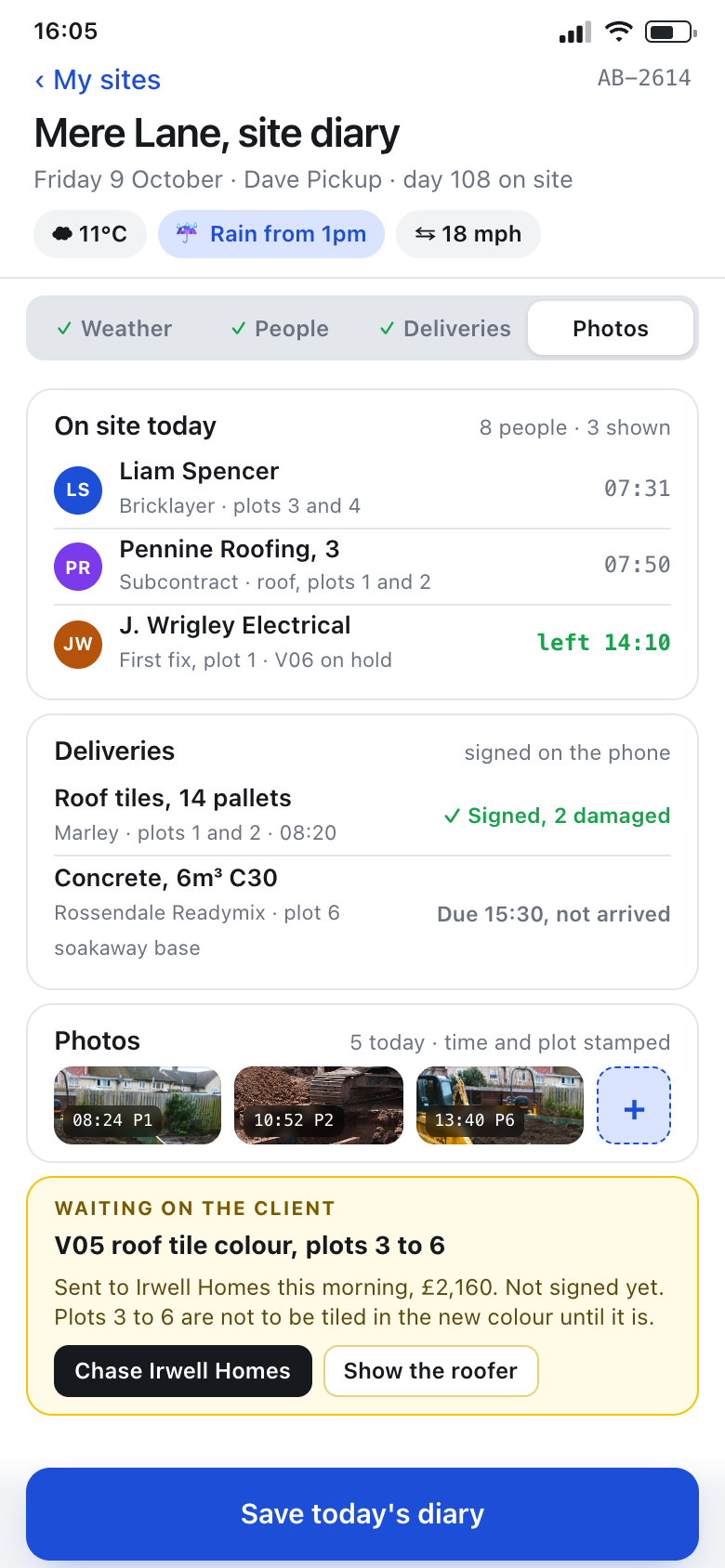
- The site diary: weather, people, deliveries, photos
- Timesheets, plant and materials booked to the job
- RAMS, certificates and subcontractor sign-offs by site
- Valuations, payments, retentions and CIS deductions
Six records describing the same job, usually kept in six different places.
A job system answers "where are we on Mere Lane, and what are we owed" without anybody ringing the site. One job is one record: the contract value, the variations on top of it, the days worked, the people and plant that went there and every valuation and payment since it started.
Plenty of firms run all of that on spreadsheets, a diary in the van and the accounts package, and it got them this far. Plenty more have estimating or accounts software that covers part of it and a sheet for the rest. The question is whether the record is written on the day the work happens, or pieced together at valuation time.
A first system might be the jobs board and variations for a dozen jobs. The same system two years on can carry timesheets from every site, subcontractors with their own logins and the valuations going out from it.
What you would be looking at, in the order a day happens
Three screens from our own example system. Real screens rather than mock-ups. The firm in them, Affetside Build of Radcliffe, is invented, and so is every job, client, person and figure. Yours would carry your job numbers, your stages and your words for things.

The day to day, in more detail
| Enquiry to final account | A job starts as an enquiry, becomes a quote, is won or lost, goes on site, reaches practical completion and closes on the final account. Each stage is a step on the same record, so nothing is retyped when it moves on. |
|---|---|
| Variations and extras | Raised on site or in the office, priced, sent to the client and marked agreed only when it comes back in writing. The email or the signed sheet is kept against it. |
| Dayworks | Labour, plant and materials for work outside the contract, recorded on the day and signed on site, then carried into the next valuation. |
| Timesheets against jobs | Hours booked to the job they were worked on, from the phone, so labour cost per job is known before the month ends rather than after. |
| Plant and materials | Hired-in plant with its on-hire and off-hire dates, deliveries signed for and booked to the job, so the cost lands where it was spent. |
| Subcontractors | Who is on which job, their RAMS and insurance, sign-offs for finished work, and what they have been paid. |
| Valuations and retentions | Each valuation with what was claimed, what was certified and what was paid, and the retention held on every job with when it is due back. |
The paperwork side of it, plainly
Most of the paperwork on a job has to be findable later. The system holds it against the site and the job it belongs to.
| RAMS and certificates by site | Risk assessments and method statements for each site, who has read them, and the certificates and test results that go with the work. A job can show which documents it is still waiting on before the start date. |
|---|---|
| CIS on subcontractor payments | Where the Construction Industry Scheme applies, the deduction is recorded against the payment it was taken from and is there to report. Your accountant or payroll still does the return. |
We build the records, not the legal or tax advice. No system makes a firm compliant on its own. Check your own obligations on health and safety with the HSE, and on CIS with HMRC or your accountant.
Who it suits, and who it doesn't
Where this kind of system earns its keep
- Building contractors, groundworkers and trades firms with somewhere between 5 and 100 people
- Several jobs on site at once, each with its own variations
- Valuations and retentions that get assembled from several sheets
- Site managers who need the same picture the office has
- Subcontractors whose paperwork and payments need keeping straight
Where we fit best
A firm running a few jobs at a time can keep them on a spreadsheet for a long time. The system earns its keep once several jobs, variations and subcontractors are moving at once, and a first step can be the job tracker on its own.
If construction software already runs the business and everybody uses it, keep it. We build what still sits beside it, the parts it was never built for, and join the two where it allows.
Where it saves time, we build in AI features too: a subcontractor's insurance and tickets checked against their record before they start, or a variation letter drafted from what was agreed on site. More on AI and automation.
Usually built alongside job tracking systems, timesheet systems, compliance and inspection records or iPhone and Android apps for site staff. Plant firms will find plant hire closer to home, and the rest are on the services page.
Ask about our free Business Systems Assessment
An hour with whoever runs the day to day. Clear recommendations to act on.
We look at how the work actually runs and what it runs on, then send you a list of what we would change, what each change would do for the business, and what it would take. In person or online, whichever suits you. Nothing to pay, nothing to sign.
- One hour
- In person or online
- Recommendations we talk you through
Honest answers
- Will it stop clients disputing variations?
- No system can promise that. What it does is make sure every variation has a record of who asked, what it was worth and whether it came back in writing, before the work is done rather than after. That is a much better place to argue from.
- We do our accounts and payroll elsewhere.
- Then they carry on doing that. Where your accounts package has an export or an interface, valuations, payments and CIS deductions land in it rather than being retyped. We hold the jobs and what happens on them, not your ledger.
- My site managers won't fill in another form.
- They already carry a phone and most already keep some kind of diary. The point is that this one is quicker than what they do now: a few taps, a photo, done. If it takes longer than the paper version, it is built wrong and we change it.
- Can subcontractors use it?
- Yes, with their own logins that only show their own jobs. They can upload RAMS and insurance, see what they have been booked for and sign off finished work. They never see your prices or anybody else's.
- How long does it take?
- A first system is usually live in weeks rather than months, and bigger ones go live in pieces so the useful part arrives early. Scope, price and dates are agreed in writing before anything starts, with what is not included written as plainly as what is. More on that in how we work.
- Where does the data live?
- On UK hosting, backed up every night with the backups kept for thirty days, and monitored every few minutes. The details are on hosting and support.
Talk to us
Tell us how jobs, variations and valuations are tracked now and what you would want to see that you cannot. That is usually enough to say whether we can help.
Ring, 8am to 6pm Monday to Friday and Saturday mornings, or use the form below. Pick what you'd like to keep track of, add a line if you want to, and leave a name and a way to reach you.