Letting agents
Letting agent compliance software
The managed portfolio on one screen. Every property, the next certificate that runs out on it and how many days are left. Gas safety, EICR, EPC, selective and HMO licences and deposit protection, each with the certificate attached to the property it belongs to. Built to sit beside the software you already run, hosted in the UK, and looked after by the people who built it.

What a managing agent actually watches
Five dates, one property
- Gas safety, annually
- EICR, on a five-year cycle
- EPC, and the minimum efficiency standard
- Selective or HMO licences, council by council
- Deposit protection and the prescribed information
A branch managing two hundred properties is watching something like a thousand dates.
A compliance register answers "what runs out next, and on which property" without anybody going to find out. One property is one record: the gas safety record and its date, the EICR and its expiry, the EPC, the licence, and the certificate itself attached rather than sat in an inbox.
This is deliberately not a CRM. The software a branch already runs was bought to let properties, and most of them do that well. The dates tend to live somewhere else, because watching them is a different job, and that second place is what we build. Nothing migrates and the property database stays where it is.
A first register might cover one branch. The same system two years on can carry three branches, contractors with their own logins, and the landlord statements coming off the back of it.
What you would be looking at, in the order a week happens
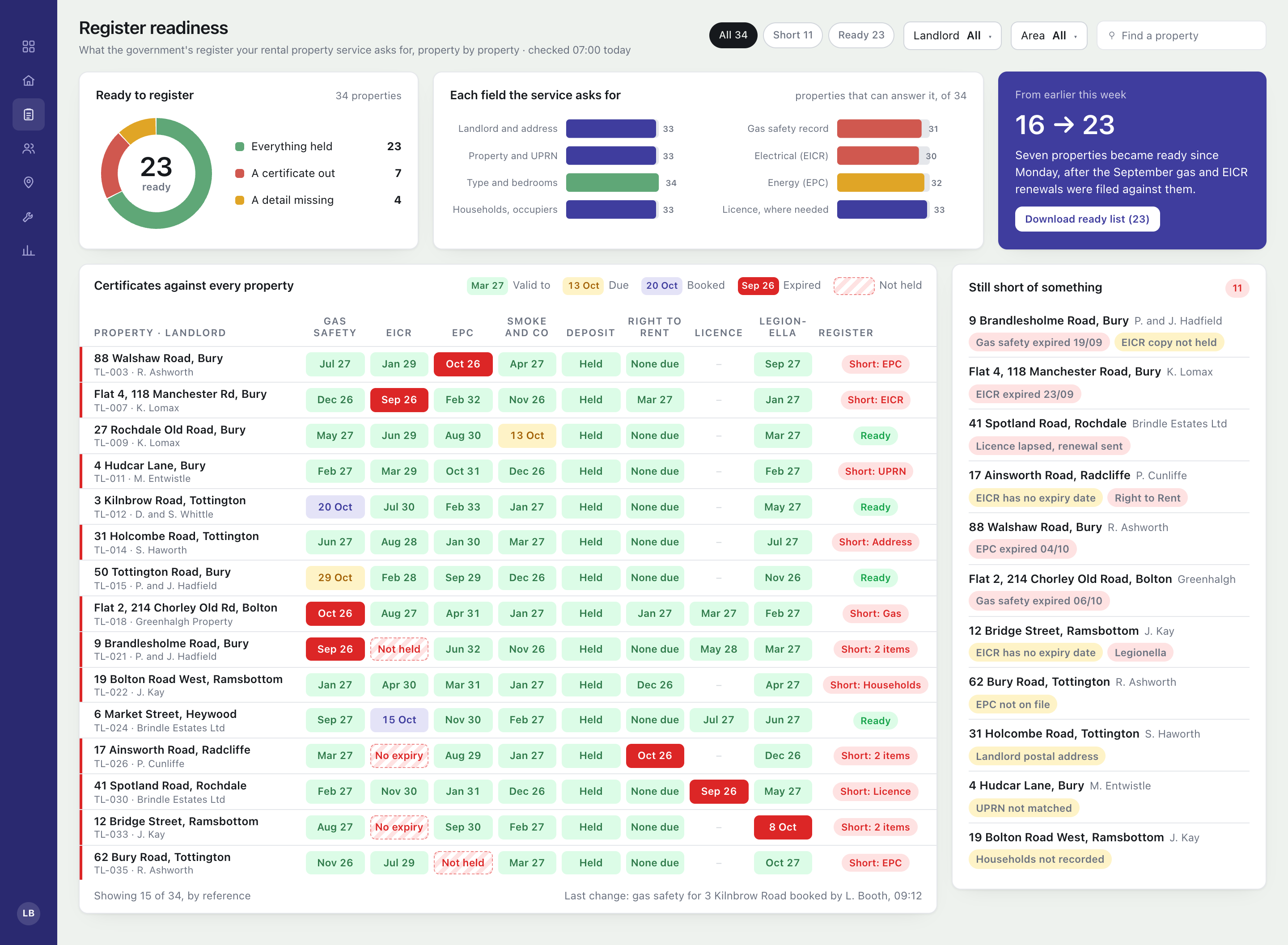
Six screens from our own example system. Real screens rather than mock-ups. Thorneyholme Lettings is an invented agency, and every property, landlord, address, tenant and certificate in them is made up. Yours would carry your branches, your certificate types and your words for things.




What the rules ask for
The Renters' Rights Act creates a Private Rented Sector Database, and the service landlords and agents use to enter a property on it is called Register your rental property. Registration opens on 15 December 2026, starting in the West Midlands and reaching the rest of England over twelve months. When a region is switched on, landlords and agents there get a three-month window to register, and every actively let property in England has to be on the database by 14 November 2027. There is a fine for missing it.
It is a records exercise rather than a change to how a property is let, which is why it lands on the agent rather than the negotiator. The entry is per property and it has to be kept current.
| Per property, not per portfolio | The address, the number of occupants, the number of households, the number of bedrooms, and the rent with how often it is paid. |
|---|---|
| The certificates themselves | A copy of the gas safety record and its issue date. A copy of the EICR or the EIC and its expiry date. A copy of the most recent EPC. |
| Kept current | A live record rather than a form posted once, which is the part a folder of PDFs and a wall planner fails at. |
None of that is hard once the certificate and its date live on the property. It is only hard when the date is in one place, the document is in another, and the occupancy is in a tenancy file nobody has opened since the check-in.
We build the records, not the legal advice. The dates and the field list above are from the government's own get ready to register guidance and the MHCLG announcement of 9 September 2026. We have not printed a date for the north west, because the government has published the launch, the window and the final deadline and not yet the regional dates in between. Check your own obligations, and if a date moves we will say so.
Who it suits, and who it doesn't
Where this kind of system earns its keep
- A managed portfolio rather than let-only
- Licensed stock, so licences with dates and conditions
- More than one council, each with its own renewal cycle
- Inspections done by somebody who is not in the office
- Landlord reporting that gets assembled by hand
Where we fit best
If your software already shows every certificate date on one screen, it is doing its job. What we usually build is the register for the dates that still live somewhere else, joined to it where it allows.
A smaller portfolio can be held by one person for a long time. The system earns its keep once more than one person needs to see the dates, and a first step can be the compliance register on its own.
The register is where most agents start, not where it stops. We also build the tenant application and referencing form that applicants fill in on their phone, with guarantors and income on it and the file arriving complete; the management side for shared and commercial property, with spaces, leases, meters, access codes, cleaning rounds and suppliers on each building; and the office's texts, WhatsApp and shared inbox kept on the property or the tenancy they are about, rather than on somebody's own phone.
And if what you want is one system across lettings, accounts and client money, that is a real project with a real budget, quoted as one.
AI features can be built in where they save time: a gas or electrical safety certificate read as it arrives and its dates and address checked against the property, or a tenant's enquiry answered out of hours and logged as a note. More on AI and automation.
Usually built alongside compliance and inspection records, asset and equipment registers or document management. The rest are on the services page.
Ask about our free Business Systems Assessment
An hour with whoever runs the day to day. Clear recommendations to act on.
We look at how the work actually runs and what it runs on, then send you a list of what we would change, what each change would do for the business, and what it would take. In person or online, whichever suits you. Nothing to pay, nothing to sign.
- One hour
- In person or online
- Recommendations we talk you through
Honest answers
- Does this make us compliant?
- No system does that on its own. What it does is hold the records in the shape the rules describe, with a date against every certificate and the certificate attached to the property. The obligation stays with the landlord and with the agent, and the advice comes from somebody qualified to give it.
- Would the properties have to move off our software?
- No, and we would argue against it. The system you run keeps the properties, the tenancies and the rent. This keeps the dates and the certificates. The two overlap on the address and nothing else, and the address list is imported rather than retyped.
- Our CRM already sends compliance reminders.
- Then the test is whether somebody can sort the whole managed portfolio on the next expiry date, on one screen, without exporting anything. A reminder about one property at a time is a reminder rather than a register, which is usually why the second list exists.
- We have HMOs across three councils.
- That is the shape this handles. Licences with different councils, different cycles and different conditions sit on the property with their own dates, and the board treats a licence expiry exactly like a gas safety expiry.
- How long does it take?
- A first system is weeks rather than months, and bigger ones go live in pieces so the useful part arrives early. Scope, price and dates are agreed in writing before anything starts, with what is not included written as plainly as what is.
Talk to us
Tell us where the certificate dates live now and what you would want to see that you cannot. That is usually enough to say whether we can help.
Ring, 8am to 6pm Monday to Friday and Saturday mornings, or use the form below. Pick what you'd like to keep track of, add a line if you want to, and leave a name and a way to reach you.