Manufacturing
Works order and shop floor software for manufacturers
Every works order from the quote it came from to the delivery note it leaves on, where each one is in the shop, the hours booked against it, the material certificates it was cut from and the inspection that signed it off. For fabricators, engineering workshops and small manufacturers of five to a hundred people, hosted in the UK and looked after by the people who built it.

What a fabrication shop actually tracks
Six records, one order
- The order, its due date and the hours quoted
- The route through the shop, operation by operation
- Hours booked against each operation, and by whom
- Material in, heat numbers, and the offcuts left over
- Inspection results and anything that failed
- Delivery notes, and the certificates that go with them
Six records describing the same order, usually kept on a board, a job bag, a spreadsheet and somebody's memory.
A works order system answers "where is that job, and will it go on Thursday" without anybody walking the shop to find out. One order is one record: the customer, the drawing and its revision, the route it takes, the hours against each step, the material it used and the inspection that passed it.
Plenty of shops run that on a whiteboard, paper job cards and an accounts package, and it got them this far. Some have planning software for part of it and a folder and a sheet for the rest. The question is whether the record is written as the work happens, or afterwards.
A first system might cover works orders, job cards and time booking for one unit. The same system two years on can carry quoting, material traceability, inspection, subcontract operations like galvanising, and a portal where customers check their own orders.
What you would be looking at, in the order a day happens
Three screens from our own example system. The firm in them, Calderbrook Fabrications, is invented, and so is every customer, order, heat number and person. Yours would carry your work centres, your routings and your words for things.
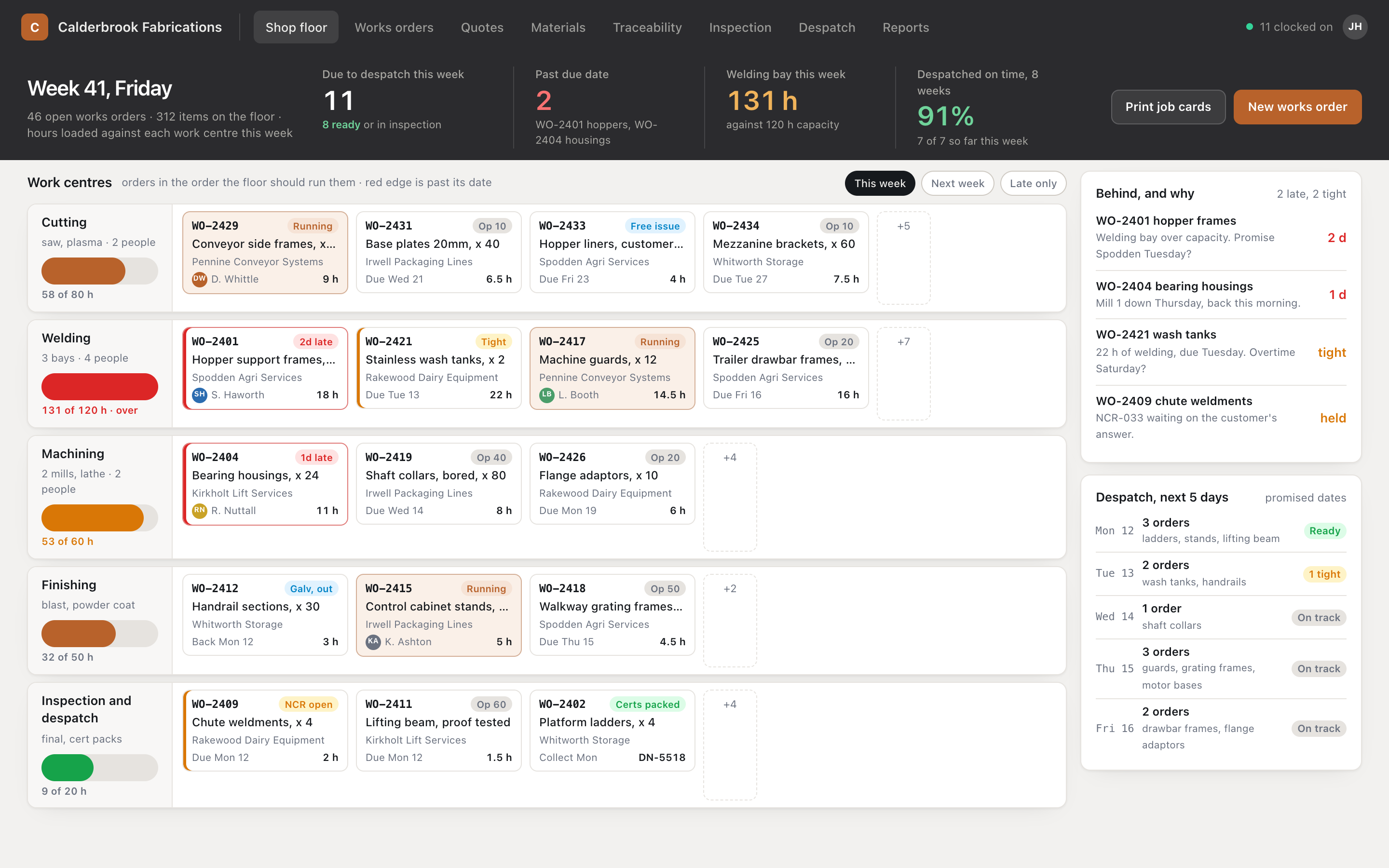
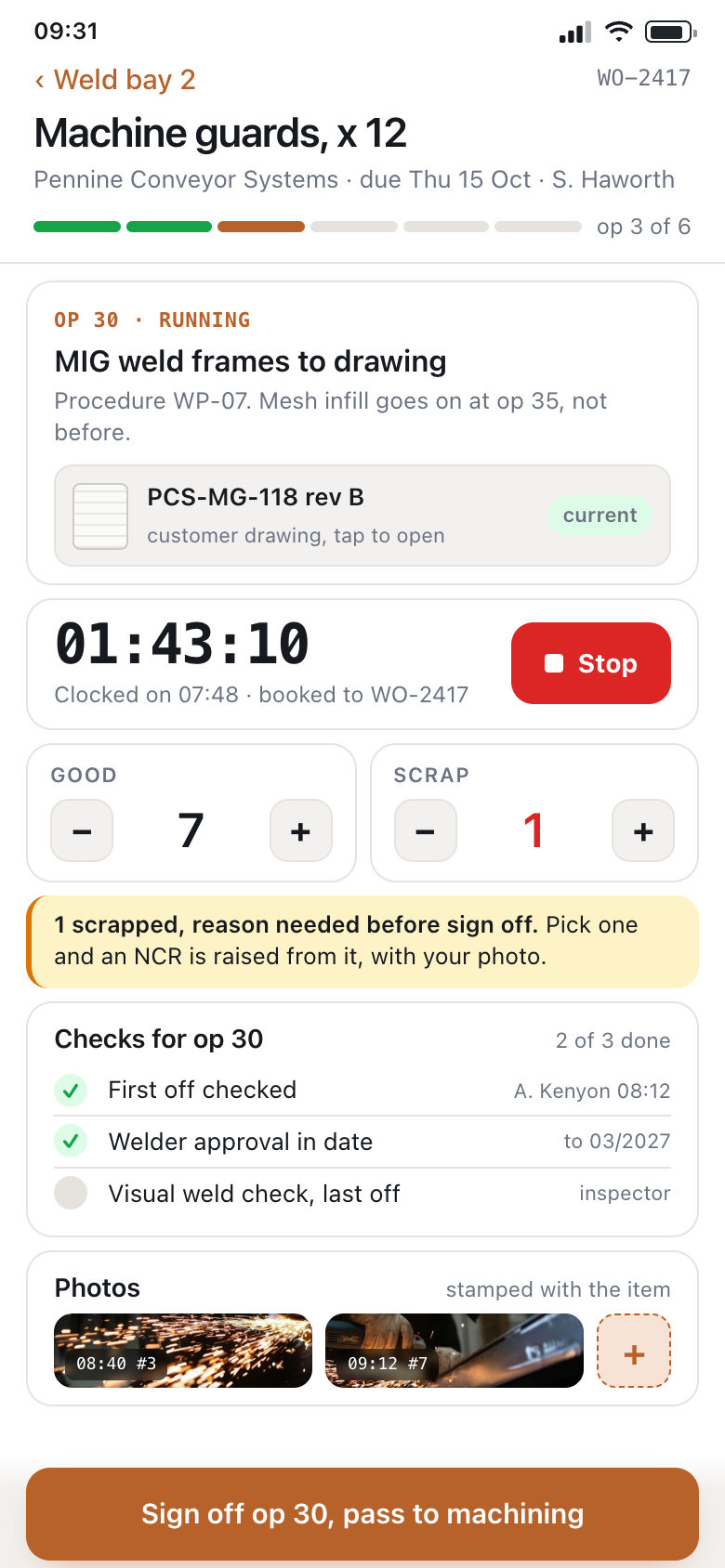
The job card, on the shop floor
What customers and inspectors ask for
Most of what a small works is asked for comes from its customers rather than from a regulator. A main contractor wants the certificate trail for the steel in a frame, and almost every customer wants to know when their order is going out.
| Material to item | Each length of material booked in with its supplier, grade, heat number and certificate. When it is cut, the pieces carry the heat with them, and so does the offcut. |
|---|---|
| The right drawing | The job card shows the drawing reference and revision the order was taken against. When the customer issues a new revision, open orders on the old one are listed rather than discovered at inspection. |
| Inspection and non-conformance | First off, in process and final checks recorded against the item by the person who did them. A failure becomes a non-conformance with a decision, rework, scrap or concession, and stays open until somebody closes it. |
| Despatch | A delivery note raised from the order, listing which items went, with the certificate pack produced alongside it rather than chased afterwards. |
None of that is hard when it is written down at the step where it happens. It is only hard when it has to be pieced together from a job bag, a certificate folder and a spreadsheet the week a customer asks.
We build the records, not the quality system. No software makes a works compliant with a standard or a customer's requirements on its own. Your quality manual, your inspectors and your certification body decide what has to be kept, and the system is built to keep exactly that.
Who it suits, and who it doesn't
Where this kind of system earns its keep
- Steel fabricators, sheet metal shops, engineering and machining workshops
- Made-to-order work, where every job has its own drawing and route
- Customers who ask for material certificates or inspection records
- Hours quoted against hours actually spent, worked out by hand if at all
- The office answering "where's my order" on the phone several times a day
Where we fit best
A small shop can run off a whiteboard for a long time. The system earns its keep once customers ask for certificates and traceability, or more than one person needs to see where a job is, and a first step can be the job board on its own.
If you run high-volume repeat production on an ERP with a planning department behind it, keep it. What usually still sits beside it is the inspection records or the certificate trail, and that is the part we build, joined to the ERP where it allows.
And if what you want is one system across quoting, production, purchasing, stock and accounts, that is a real project with a real budget, quoted as one.
Where it saves time, we build in AI features too: a customer's order email or PDF read into a draft works order, or a material certificate checked against the batch it arrived with. More on AI and automation.
Usually built alongside job tracking, quoting, stock and batch control, compliance and inspection records or a customer portal for order status. The rest are on the services page, and how we work explains what happens between a free 20-minute intro call and go-live.
Ask about our free Business Systems Assessment
An hour with whoever runs the day to day. Clear recommendations to act on.
We look at how the work actually runs and what it runs on, then send you a list of what we would change, what each change would do for the business, and what it would take. In person or online, whichever suits you. Nothing to pay, nothing to sign.
- One hour
- In person or online
- Recommendations we talk you through
Honest answers
- Will this get us through an audit?
- No system does that on its own. What it does is hold the records an auditor or a customer's inspector looks for, against the item they belong to, with a name and a time on each. The quality system stays yours, and so does the judgement on what it needs.
- The shop floor won't book time on a phone.
- A tablet on the bay wall works as well as a phone. There is nothing to install, and we take people through it on the shop floor before go-live rather than leaving you to explain it.
- We invoice from our accounts package.
- Then it carries on doing that. Where your accounts package has an export or an interface, the order and the delivery note land in it rather than being retyped. We hold the works and what it is doing, not your ledger.
- Our customers want to see their orders.
- That fits. A customer logs in and sees their own open orders, where each one is, the promised date, and the delivery notes and certificates for what has gone. They see nothing of anybody else's and nothing you have not chosen to show.
- How long does it take?
- A first system is weeks rather than months, and bigger ones go live in pieces so the useful part arrives early, usually the board and the job cards first. Scope, price and dates are agreed in writing before anything starts, with what is not included written as plainly as what is.
It is hosted in the UK, backed up nightly with backups kept thirty days, and checked every few minutes. Hosting and support has the detail.
Talk to us
Tell us how works orders move through the shop now and what you would want to see that you cannot. That is usually enough to say whether we can help.
Ring, 8am to 6pm Monday to Friday and Saturday mornings, or use the form below. Pick what you'd like to keep track of, add a line if you want to, and leave a name and a way to reach you.